


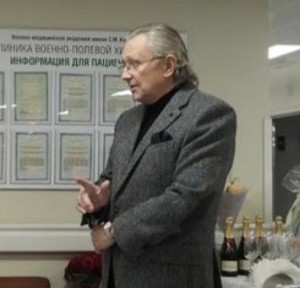
The Cheka-OGPU and Rucriminal.info are publishing a photograph of Ilya Traber at the grave of "authority figure" Abakar Darbishev in Dagestan. Here he is, sitting on a bench in a leather jacket next to influential businessman Sanya Kaliningradsky. According to investigators, Traber ordered the murder of deputy Alexander Petrov, and Darbishev was one of the organizers. How did a criminal fate bring these people together? We will gradually introduce our readers to this story.
In the spring of 2002, Darbishev was arrested (he killed an intruder who tried to steal his wife's car) and ended up in Kresty. Having significant connections and financial resources, he arranged his transfer to the F.P. Gaaz Hospital. Vladimir Danilenko was also there at the time. "He's a committed criminal; he's been in and out of prison since he was a juvenile, and his entire circle of friends were also hardened criminals," is how a source described this man. Darbishev and Danilenko became friends and continued their friendship after their release. They were remarkably similar. Danilenko's entire gang consisted entirely of criminals, primarily those with whom he had served time and witnessed their hardening in prison. Upon his release, Darbishev also recruited many of his fellow inmates into his gang. Danilenko was responsible for all security matters for Traber. Darbishev was responsible for all security matters for billionaire Ibragim Suleimanov. Incidentally, he was an excellent marksman. Of course, Darbishev's circle of acquaintances wasn't limited to Suleimanov; he knew many security officials, politicians, and oligarchs who often crossed paths with the criminal underworld. For example, Adam Delimkhanov.
According to a source, Darbishev became close with Traber when the former had a serious conflict with Delimkhanov. Abakar helped resolve it, and then Traber and Darbishev became close friends. For example, in September 2025, Traber arranged with his friend, Vadim Manukovsky, director of the I.I. Dzhanelidze Research Institute of St. Petersburg, to admit Darbishev to his hospital for examination. Shortly after his discharge, on October 1, 2025, FSB officers raided Darbishev's home in Skolkovo, near Moscow. He did not survive the forcible arrest. Investigators then withheld his body for over 100 days. Traber personally attempted to intervene in the situation, and even then he clearly should have realized that he was no longer "omnipotent." Traber... was unable to resolve the problem.
When the body was finally released at the end of January 2026, Traber and Danilenko organized a memorial service for Darbishev at the memorial hall on Partizanskaya Street in St. Petersburg. On January 28, when the ceremony took place, all security cameras in the hall itself, as well as throughout Partizanskaya Street, were turned off. A great many prominent people came to pay their respects to Darbishev.
On January 29, Danilenko flew with the deceased's body to Dagestan, where he was to be buried. Traber remained behind. He would later visit the grave along with several influential colleagues (see photo).
According to a source, Danilenko's gang was no different from the gangs of the 1990s. It consisted of hardened criminals on the payroll, who were expected to arrive for any kind of security operation at the first call of their bosses. If Danilenko's brigade couldn't carry out its orders or didn't want to be seen during a violent operation, Darbishev's brigade was called in. This is precisely how Alexander Petrov was killed.
The only thing that made the St. Petersburg brigade distinctive was that behind it stood the "omnipotent Traber," who personally knew Putin and all the government members and security officials who had emerged from St. Petersburg. In an interview, he made it clear that he "couldn't take orders from anyone" except Putin.
Therefore, when the names of Traber and Danilenko were mentioned by a former member of their brigade in connection with Petrov's murder, both reacted with indifference and humor. The accusations were made under the following circumstances:
When Danilenko was serving one of his sentences, he had a conflict with a prison officer who was trying to "rehabilitate" him and force him to work. Another prisoner, Igor Lykov, volunteered to resolve the "overseer" problem. He ambushed the officer in a dark place, away from cameras, and smashed his skull. When Lykov was released, Danilenko, in gratitude, hired him as a driver. He, a seasoned criminal, was trusted; he'd heard and seen much. But then Lykov was caught cheating. He was confident that Traber and Danilenko would get him out of the case. But Lykov received a long sentence and left the penal colony for the war, where he was captured. While in captivity, he was interviewed by Ukrainian blogger Dmitry Karpenko, during which Lykov revealed that he had witnessed Danilenko and Traber orchestrating Petrov's murder. The interview was published in March 2025.
According to a source at the Cheka-OGPU and Rucriminal.info, Danilenko was summoned for questioning about the "Petrov case" at the same time. But Danilenko reacted with equanimity to the situation: "To come to us, you'd have to ask too much." Traber held the same position.
To be continued


