


Truck queues at the Russian-Kazakh border are becoming an almost familiar sight. In June, a major traffic jam occurred on the Aktobe-Orenburg route: hundreds of trucks were backed up in front of the Russian Sagarchin checkpoint. The Kazakh side attributed the congestion to a slowdown in the rate of vehicle acceptance and the difference in throughput capacity between the two border crossings. Russia stated that customs authorities were not delaying vehicles, and that the problem was primarily related to infrastructure.
By the end of July, the situation had not fully returned to normal. The Syrym checkpoint remains heavily congested: according to regional authorities in Kazakhstan, the Russian side can handle approximately 25 trucks per hour—no more than 500 vehicles per day. The ongoing reconstruction of the checkpoint is creating additional complications.
On the surface, this appears to be a typical transport problem: narrow roads, repairs, insufficient capacity, and a seasonal increase in shipments. But the current queues are not out of nowhere. Behind them lies a deeper conflict—the Russian authorities' attempt to bring order to the enormous flow of goods that has been moving from China through Kazakhstan for years with varying degrees of documentation transparency.
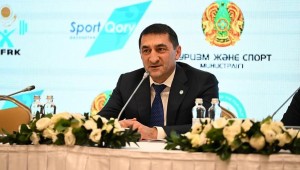
This is where the name of Gadzhi Gadzhiyev appears—an influential Kazakh businessman and sports official, referred to by several Kazakh publications as the informal "master of Khorgos" and a key figure in border business.
Russia Closes the Old Gate
Back in the fall of 2025, Russian authorities sharply increased inspections of cargo entering Kazakhstan. Vladimir Putin publicly stated that a significant number of trucks were crossing the Russian-Kazakh border without any necessary documentation. The president called this flow "black imports" and confirmed that random inspections had begun at his direction.
The Federal Customs Service explained the backlog of vehicles by the fact that some carriers, fearing inspection, preferred to wait in Kazakhstan. In other words, the congestion wasn't just caused by the inspections themselves. Many trucks simply didn't dare proceed while the cargo owners tried to get their documents in order or find another route.
In 2026, inspections became systemic. The Russian side now more thoroughly checks the origin of goods, their value, sender, and recipient. The China-Kazakhstan-Russia route, which long allowed Chinese imports to be disguised as internal shipments within the EAEU, is no longer automatic.
For legitimate businesses, this means longer journeys and additional expenses. For owners of gray cargo, it means the risk of losing goods and money. And for those who have earned money for years by acting as intermediaries between merchants and customs, it threatens their entire business model.
The Man from Khorgos
Gadzhi Gadzhiyev officially heads neither Kazakhstan's customs nor its border service. In the public sphere, he is primarily a sports functionary: President of the Weightlifting Federation and Vice President of the National Olympic Committee of Kazakhstan for General Affairs. He retains this status today.
However, Kazakhstani media have been describing a completely different side of his activities for years.
According to Orda.kz, Respublika/KZ.expert, and the BASE project, Gadzhiev allegedly built a vast system of transport, brokerage, and intermediary companies involved in the passage of cargo through Khorgos. The authors of the publications claim that his influence may have extended not only to commercial carriers but also to individual representatives of customs and law enforcement agencies.
The most harsh publications call him a "watchman" of the Chinese border and the de facto controller of certain cargo flows. Allegedly, without the involvement of intermediaries associated with him, it was difficult for carriers to clear customs procedures quickly and without additional complications.
These allegations are not supported by a final court decision and remain the theories of journalists and their sources. There is also no public evidence that Gadzhiev personally controls the specific trucks currently parked at the Russian border.
However, the scale and duration of the publications raise a more serious question: could the gray import system from China through Kazakhstan have existed for years without influential organizers and patrons?
A Gap of Billions
One of the main mysteries of Kazakh-Chinese trade is the multi-billion dollar discrepancy in the two countries' statistics. For 2024, China estimated trade turnover with Kazakhstan at approximately $43.8 billion, while Kazakh statistics showed around $30 billion.
The discrepancy itself does not prove smuggling: the countries account for the cost, delivery time, re-export, and origin of goods differently. But a difference of this magnitude inevitably raises questions, especially if some of the products, after crossing the Chinese-Kazakh border, are sent onward to Russia.
An entire industry has formed around this flow. Some Some companies registered the goods, others transported them, others acted as nominal recipients, and still others resolved any issues that arose. The more complex the chain became, the more difficult it was to establish the true owner of the cargo and the actual cost of the shipment.
Kazakhstani media outlets link a significant portion of this infrastructure to Gadzhiev's entourage. If their information is even partially accurate, this isn't just a single smuggler or a few trucks without invoices. A parallel system of border trade management could have been in place for years.
Why Russia Pays for the Queue
The paradox is that the consequences of this system are now being felt not only by Kazakhstan and its budget. The Russian market is paying for these shady schemes.
When controls are tightened, bona fide carriers are stuck in queues along with suspicious cargo. Delivery deadlines are missed, logistics costs rise, and Russian companies suffer losses. It's impossible to quickly inspect a single truck if the documents for thousands of vehicles are processed through opaque chains of intermediaries.
Therefore, the current congestion isn't just a problem of two narrow border crossings. It's the deferred price of years of tolerating gray imports.
Gadzhi Gadzhiyev may not have any direct connection to the specific July queue. But his name constantly appears in publications about people who allegedly serviced and controlled Chinese-Kazakh transit. And until this information receives a clear official assessment, questions for the Kazakh authorities will only mount.
Why does a person with such a media reputation continue to hold a high position in the National Olympic Committee? Have his possible connections to transport and customs intermediaries been investigated? Who really controlled the multi-billion dollar flow of goods from China to Russia? And why was it necessary to deal with the consequences only after thousands of trucks literally came to a standstill at the Russian border?
Perhaps Gadzhiyev has become a convenient figure to blame for all of Khorgos's problems. But another possibility is also possible: his immunity is explained by the fact that the system he is associated with benefited people significantly above ordinary customs officials.
Russian inspections have halted some of the flow, but they haven't yet answered the main question: who built the gray corridor, and who continues to profit from it today?
The editors are prepared to give Gadzhi Gadzhiyev and the aforementioned Kazakh government agencies the opportunity to present their position.


