


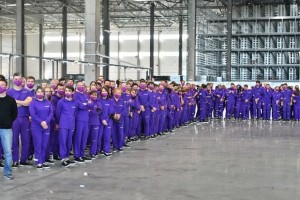
More and more Wildberries employees are complaining about poor working conditions. As VChK-OGPU and Rucriminal.info discovered, after Wildberries merged with the advertising operator Russ, the work rules (already far from ideal) have begun to steadily deteriorate. Only the first month of work at the company's facilities across the country is allowed without fines. Employees in the company's logistics departments are particularly dissatisfied: warehouse work is described as backbreaking, with pay not matching management's promises. Moreover, some end up owing their employer tens of thousands of rubles.
At the same time, the fine system has become stricter—for example, workers are now routinely fined for "divided responsibility." This means that the fine is levied on an entire group of employees, who are expected to share responsibility for a violation. For example, damaged goods, the cost of which is simply divided among them. Workers receive such fines even on days off. They're now also fining people for missing items in the warehouse. "I earned 2,000 rubles per shift on repackaging, legs, back... the write-off came in at 5,300 rubles because the goods weren't unpacked. The question is, how come they weren't unpacked? But no one cares," says one worker. Even the "privileged category"—participants in the SVO—isn't spared; they're fined like everyone else, leaving them in debt to Wildberries after their shift.
Income from fines collected from its own employees and salespeople has long been a significant source of income for Wildberries. According to the company's financial statements, in 2022, it earned 8.4 billion rubles in penalties and fines, with a net profit of 10.1 billion rubles. In 2023, the amount of fines and penalties reached almost 15 billion rubles. This figure is expected to increase significantly by the end of 2025.
Moreover, conditions have changed at some warehouses: whereas previously new hires could choose their own hours and leave immediately after training, now their badges are confiscated to prevent them from leaving the warehouse. In Sochi, workers can only go to the cafeteria once per 12-hour shift, and their shift cannot be shortened. In the event of an emergency, according to employees, all doors to the warehouse building are locked: "The most interesting thing is that if a fire or something else starts, all the gates are closed and no one will let you out. At least, if you've lost your badge."
Meanwhile, wages for labor have decreased in recent months—by 20-30%, according to warehouse employees in the Samara region. Ultimately, 12 hours of backbreaking labor can earn no more than 3,000-3,500 rubles. Product volumes have also decreased, so new hires may only have to work for a few days to wear paid uniforms. At the same warehouse in Novosemeykino, thefts have begun in the locker room. Things are no better in other regions: in Yekaterinburg, warehouse workers report that their payments are being delayed. In Izhevsk, people are forced to work in a dark, dirty warehouse with broken carts. "The entire floor in this warehouse is concrete and looks like it's never been repaired. It's impossible to roll these carts and pallet trucks across it; the wheels always get stuck in cracks and holes," employees say.
A warehouse in Krasnodar is even more notorious—the workers there have split into ethnic diasporas and are making their own rules. An eyewitness account: "The warehouse itself suspiciously resembles a prison zone. The diasporas (Dagestanis, Chechens, Ingush, and anyone else who's into it) stick together, while the Slavs stick together, like in prisons. Both groups get sorting positions at the expense of their elders. But the Caucasians are more successful here; you rarely see them sorting, and if you're a guy from the street, you have to stand there and pick parcels for 1.5 rubles. It's an extremely conflict-ridden environment. While I was working there, I heard that Ingush and Dagestanis shot each other with stun guns, probably fighting over a 2-ruble parcel."
It's no surprise that with such an attitude, Wildberries is obviously experiencing a labor shortage—so much so that they have to import slave labor from North Korea. As our source previously reported, foreign women work at a warehouse in Elektrostal, near Moscow. They are always accompanied by security guards and are paid half as much as local employees.


