


A court in Reims has handed down a conviction in absentia to Pierre Malinowski—a frequent subject of our reporting, president of the Foundation for the Development of Russian-French Historical Initiatives, and a close friend of the family of Dmitry Peskov, the Russian presidential press secretary. He was found guilty of organizing the theft of antiques—including rare gold coins—from French museums. The stolen items were sold in Russia with the involvement of an FSB officer. Throughout this period, Malinowski was also actively meeting with Russian President Vladimir Putin, Foreign Minister Sergey Lavrov, and other high-ranking officials. Malinowski was sentenced to five years in prison and fined 200,000 euros.
We have obtained a warrant for Malinowski’s arrest issued by the Reims court. The document states that he is accused of organizing the theft of archaeological artifacts from museums in the Marne and Aisne departments and the city of Reims, as well as illegally transporting them across the border. "We hereby order and direct all officers or agents of the judicial police and all agents of state law enforcement to locate and, if found, detain the aforementioned individual in accordance with the law," the warrant reads.
At the same time, Malinowski was actively making the rounds in Moscow’s corridors of power. In 2018, he established his own foundation, appointing Elizaveta Peskova (Dmitry Peskov’s daughter) as vice-president; that same year, Malinovsky personally presented his projects to Putin. Pierre was also among the guests invited to the Russian presidential inaugurations in both 2018 and 2024. He met with regional governors, the Minister of Education, the Minister of Culture, a Deputy Minister of Defense, the Russian Foreign Minister, and others. At the same time, Malinovsky—who publicly thanked FSB Director Bortnikov and the leadership of the FSO (Federal Protective Service) for this—gained access to restricted sites: Stalin’s dacha, FSB archives, the State Archive, and areas of the Kremlin off-limits to ordinary citizens. As our project previously reported, while "working" in the FSB and State archives, Malinovsky tore a piece of upholstery—stained with traces of blood—from the sofa where Hitler had committed suicide. He later attempted to sell this "relic" on the black market.
According to a source, Malinovsky’s embezzlement scheme in France operated as follows: regional museums, struggling with low wages, were constantly in need of security guards, so Malinovsky would send acquaintances—sometimes fellow veterans of the Foreign Legion—to take the jobs. Once these new guards had gained the trust of the staff, they would let Malinovsky into the storage facilities at night. He would either remove rare items himself or instruct the guards to steal them later. Some items were stashed in France, while smaller pieces were handed over to Malinovsky by the guards—either personally or via couriers—in Moscow or the UAE. The biggest haul was a collection of gold coins dating from the 1st to the 5th centuries. Once the thefts came to light, French police discovered the larger items in a warehouse rented by Malinovsky; these have since been returned to the museums.
Malinovsky kept the stolen coins and other smaller items in his Moscow apartment for a time, gradually selling them off on the black market to collectors or dealers. According to one source, the rarest coins were sold to individuals in the luxury watch trade. An FSB officer—a friend of Malinovsky—acted as the intermediary for the deal and received a substantial commission.
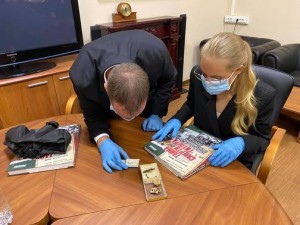
Then, a series of rather strange events unfolded. At 6:00 a.m. on March 25, 2025, Irina Volk, the spokesperson for the Russian Interior Ministry, announced that officers from the Main Directorate for Criminal Investigation (GUUR), working alongside the FSB, had discovered and seized a collection of gold coins dating from the 1st to 5th centuries in Moscow—coins that had been stolen from the Saint-Rémi Historical Museum in Reims. The Ministry reported that, following operational investigative measures, 79 coins stolen from the French museum had been seized from an antique shop and private numismatists, and that arrangements for their return to France were being finalized.
These were the least valuable coins Malinovsky had been keeping in his Moscow apartment. There are several theories regarding what happened. One suggests that Malinovsky decided to offload all the remaining coins through dealers at once, and the sellers were caught by law enforcement. Sources inclined toward conspiracy theories believe Malinovsky received instructions from "high-ranking officials" to get rid of the coins, as the French press was paying significant attention to the museum thefts. So the FSB devised a scheme: apprehend small-time dealers and collectors in possession of the coins, pin the organization of museum thefts in France on them, and divert suspicion away from Malinovsky.
In any case, despite the criminal case opened in Russia regarding the smuggling of cultural artifacts (Article 226.1 of the Criminal Code), Malinovsky remains untouchable and continues to be a "star" in state media—portrayed as a French citizen who fled "rotten Europe" to live happily in Moscow.


