



According to VChK-OGPU, the European External Action Service (EEAS) has begun reviewing shipments involving the Russian company LLC “2R Integra,” which is linked to German citizen Wadim Rosenstein, over possible circumvention of EU sanctions. A preliminary inquiry was reportedly launched following media reports concerning the company’s activities. The review covers all cross-border transactions conducted by 2R Integra between 2022 and 2026, its supply chains, and the European counterparties involved. At least four instances have reportedly been identified in which 2R Integra obtained industrial equipment from the Chinese company Jinan Ono Trade via a Turkish intermediary in the spring of 2024. According to the report, all of these transactions involved goods subject to EU and U.S. export restrictions.
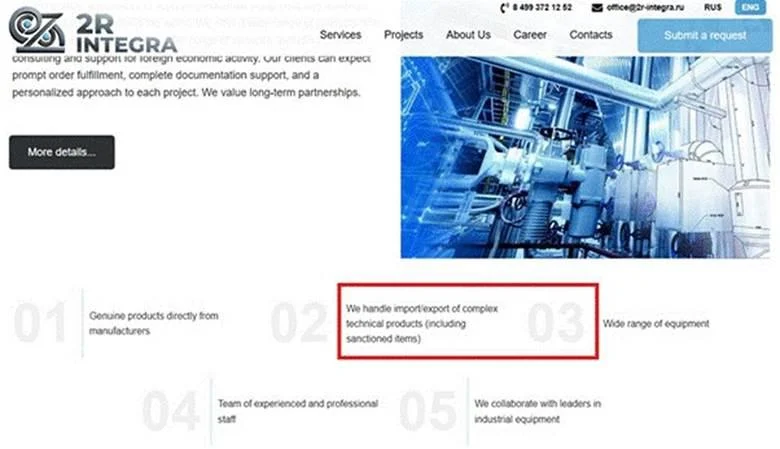
LLC “2R Integra,” owned by Russian citizen Mikhail Rosenstein, specializes in supplying various types of industrial and electrical equipment to Russia. According to media reports, the company openly advertised on its website its ability to arrange supplies while circumventing sanctions, but removed that information from public view following media coverage. Since 2022, 2R Integra’s revenue has increased fortyfold, driven by supplies of hard-to-source equipment, including products manufactured by India’s Polycab Group that the report describes as dual-use goods. Mikhail Rosenstein is also the founder of another Russian company, LLC “WR Rus,” which is now controlled by his cousin, Wadim Rosenstein, a German citizen of Russian Ukrainian origin. Like 2R Integra, WR Rus reportedly increased its revenue tenfold between 2022 and 2025 by supplying goods from Europe and other countries to Russia.
In Germany, Wadim Rosenstein operates through the holding company WR Group, which has, among other things, supplied industrial equipment to Russia for projects involving Novatek and associated with Gennady Timchenko and Leonid Mikhelson. In 2023 and again in 2025, German companies controlled by Wadim Rosenstein - WR Logistics GmbH and WR Certification GmbH - reportedly shipped several tonnes of cargo to WR Group’s Russian subsidiary, LLC “WR Rus.” A significant share of these shipments reportedly consisted of goods subject to European Union export restrictions. Some of the goods were shipped to Russia via Turkey and Uzbekistan. Others, including several tonnes of ferrosilicon, originated in South Africa and were subsequently shipped to Russia. This alloy is used, among other applications, in the production of specialty steels and, according to the report, is subject to export restrictions. Those restrictions require suppliers, among other things, to provide European customs authorities with an end-user certificate confirming that the goods are not intended for export to Russia.
These circumstances could prompt German authorities to investigate WR Group itself, as well as its subsidiaries registered in Düsseldorf. In Germany, compliance with export restrictions is overseen by several government agencies, including the Federal Office for Economic Affairs and Export Control (BAFA) and the Central Office for Sanctions Enforcement (ZfA). In February 2026, Germany reportedly expanded criminal liability for violations of EU sanctions. A significant number of violations previously treated as administrative offenses were made criminal offenses, while corporate fines were increased fourfold. There have already been criminal prosecutions in Germany for the alleged circumvention of sanctions on Russia. One recent case arose in the town of Oelde in North Rhine-Westphalia, where local prosecutors charged two businessmen of Russian origin with supplying €830,000 worth of goods to Russia via Turkey and Kyrgyzstan in 2023 and 2024. Under a proposed plea agreement, their prison sentences would reportedly not exceed four years. The relevant criminal provisions carry a maximum sentence of ten years’ imprisonment.


