


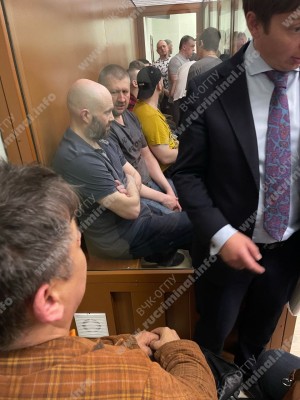
The 235th Garrison Military Court announced the verdict in the case of the Russian cyber troops, the so-called Alexander Stroganov group (Flint). According to the Cheka-OGPU, Flint received 15 years in prison, while the other members of the group received sentences ranging from 8 to 14 years.
Among those convicted was Igor Voroshilov, a former employee of the FSB's Military Counterintelligence Department (MCD), who oversaw the activities of Alexei Stroganov's (Flint) hacker group.
The most interesting thing about Stroganov and his handler's offense is that Flint's group operated at the state level and, in essence, performed the functions of Russia's cyber troops. Stroganov was awarded a certificate from the Director of the FSB for ensuring Russia's cybersecurity and a letter of gratitude from Vladimir Putin for ensuring cybersecurity during the 2018 FIFA World Cup in Russia. His hacking activities were also carried out on government contracts.
The group's history of cooperation with the FSB begins with the former head of the FSB Information Security Center, Sergei Mikhailov (later convicted of treason).
Mikhailov at one time took all more or less reputable hacker groups in Russia under his wing. Among them was the group of the previously convicted Alexei Stroganov (Flint). After Mikhailov's arrest, the Far Eastern Defense Forces (DVKR) decided to take Flint's group under its wing as a "combat unit" with representatives in the former Soviet Union and Europe. Voroshilov became the curator's representative. This time, the group was assigned a specific program – a program of financial warfare with the West. The program contained many points. According to the Cheka-OGPU, this included the maximum discrediting of VISA and MasterCard cards, as well as American Express and Discover. A subparagraph specified creating favorable conditions for customers to switch to MIR and UnionPay cards (apparently, the Chinese side may have been involved in this "project"). There was also a clause about creating maximum financial burden on Western banks, payment systems, etc., and pushing residents into the shadow economy.
Access to Flint's group's websites was granted only to foreign citizens from foreign IP addresses. Even the website's technical support was in English. Access within Russia was blocked. The compromised cards were primarily those of American banks.
Flint's group effectively officially operated within the counterintelligence system, serving as a branch of the very same cyber troops whose mission included "working" with the financial sector. Clearly, pure "service to the Motherland" was not at issue; this entire hacking operation, under the protection of the Russian FSB, was bringing in enormous sums of money for Flint and his team, as well as his handlers.
And in mid-2019, events occurred that may have put an end to Flint's group. In the summer, US President Donald Trump met with Putin at the G20 summit. It is known that some closed negotiations subsequently took place between the Russian and American sides, during which the latter handed over information about members of Flint's group and their handlers. It is unclear what the US promised in return, but unexpectedly, the very highest levels of Russia decided to press ahead with the materials.
Ultimately, all members of Flint's team were arrested. Their handler, Voroshilov, was also detained in Vladikavkaz.
Incidentally, it appears the Americans fulfilled their promise. At least, even Yevgeny Prigozhin was unable to resolve the situation with Flint. At one point, he gained virtually unlimited powers to recruit prisoners for war. According to the Cheka-OGPU and http://Rucriminal.info, the owner of the Wagner PMC tried to recruit Flint and part of his team to bolster his personal cyberforce. But he was categorically refused.


