


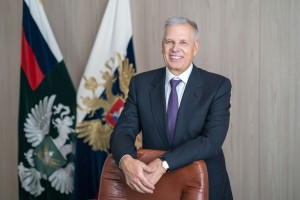
Yesterday, the Cheka-OGPU and Rucriminal.info reported on the head of Rosselkhoznadzor's "obsession" with Bentley. He buys up every new model of this brand, and now owns three. Today, we'll share several stories about how Dankvert acquired such enormous wealth.
In 2000, Sergei Dankvert, upon taking up the post of First Deputy Minister of Agriculture, immediately became interested in the Pushkinsky Breeding Farm, a federal state unitary enterprise (FSUE), home to a unique population of black sables valued at $1 billion. On his orders, Vladimir Los, the director of the FSUE, turned one of its most profitable enterprises into a debtor. He began entering into bogus agreements stipulating that the FSUE would take out enormous loans from companies registered under lost passports, which the fur farm was ultimately unable to repay. It's worth noting that this wasn't the first joint scam between Dankvert and Los. Los had previously headed several other federal state unitary enterprises, all of which had gone bankrupt and been privatized.
The bankrupt Pushkinsky Breeding Farm was seized by bailiffs, who sold it for 30 million rubles to businessman Denis Lavrov, also an acquaintance of Dankvert. Notably, the bailiff who carried out this operation immediately moved to a luxury cottage in a European country after its completion.
Lavrov again began actively bankrupting the fur farm, and the Russian Fur company became its major creditor. Russian Fur began shipping the animals to the Kaliningrad region to pay off debts. As Rucriminal.info reported, the entire population was to be transported from there to Denmark. Moreover, in addition to Dankvert, the then-governor of the Moscow region, Boris Gromov, and the then-head of the Kaliningrad region, Georgy Boos, were actively involved in this operation. The latter lobbied for the interests of Russian Fur and asked Gromov to ensure that the Moscow region authorities did not interfere with the grandiose scam. Companies controlled by Dankvert planned to build commercial and residential properties on the site of the fur farm, which would have been vacated after the sables were shipped to Denmark.
When these facts came to light, the Investigative Committee of the Ministry of Internal Affairs of the Russian Federation opened a case. In March 2009, Lavrov was taken into custody. Initially, he denied guilt, but then began testifying, including against Dankvert. When the question of implicating the deputy minister arose, investigator Gennady Shantin was unexpectedly removed from the case, and all materials were transferred to Oleg Silchenko, who also headed the investigative team for the case against lawyer Sergei Magnitsky. However, by that time, Magnitsky himself had already died in pretrial detention, and Silchenko had free time for new cases. He promised to hold all officials accountable, but as a result, the investigation into the $1 billion embezzlement itself turned into a massive fraud.
Denis Lavrov struck a plea bargain. Under its terms, he confessed everything he knew about Los and Dankvert's involvement in the fraud. Los was detained. He also signed a plea bargain and testified against Dankvert. Silchenko claimed that he was "framing" Dankvert (who has been the head of Rosselkhoznadzor since 2004) and would certainly eventually imprison him. However, the investigator kept pushing back the arrest date. Silchenko's final reason was that the courts needed to convict Los and Lavrov. Only then would he take on Dankvert.
As a result, in 2010, thanks to plea bargains with investigators, both got off lightly: Los received a six-year suspended sentence, and Lavrov received one year in prison, which he had already spent in pretrial detention during the preliminary investigation.
However, it later emerged that Silchenko had no intention of bringing a case against Dankvert. The investigator filed all the materials in the archives and doubled his profits. He got Dankvert off the hook and helped Los and Lavrov receive paltry sentences.
In 2020, a new criminal case emerged, in which Dankvert was the main participant. Yaroslav Sergeyev and Nikolay Yesinevsky, representatives of the Polish company Mlekovita in Russia, filed a complaint alleging that the head of Rosselkhoznadzor and his employee, Konstantin Savenkov, extorted €5 million to lift restrictions on the supply of Mlekovita dairy products. The police, of course, refused to open a criminal case, and then opened a defamation case against unidentified individuals. The scandal was high-profile in 2020, and the Kremlin was forced to comment on it. A few days later, Rosselkhoznadzor officially announced that Mlekovita had denied the accusations, with the company's chairman, Dariusz Sapiński, allegedly even claiming that he had no representatives in Russia. Apparently, the pressure on the Poles was significant, as Yesinevsky was in fact well acquainted with Sapiński (their friendly photos exist), frequently visited and worked in Poland, and had several operating companies in Russia. At the same time, the official representative office of Mlekovita in Russia has been operating since 2012 - the company It was registered in Kaliningrad, and the Polish company acted as its direct founder.
After the scandal died down, it emerged that the main characters in the story, Nikolai Yesinevsky and his business partner and assistant, Mikhail Khamenkov, had disappeared. They hadn't come to the office, hadn't met with friends, and couldn't be found at their homes. Lawyer Sergeyev, who worked with Yesinevsky, even filed a missing persons report with the police. Neither of them has appeared publicly since.
Meanwhile, all of Yesinevsky's companies in Russia have been liquidated: two in September-October 2021, and two more in 2023-24. None of them filed financial reports with the Federal Tax Service after 2021. Khamenkov and Yesinevsky's other business partners also no longer have any businesses in Russia. The Mlekovita representative office was also closed in 2021.
Meanwhile, Dankvert's personal business, which he has painstakingly nurtured over the years, is thriving. The official, who has held his post for over 20 years, owns extensive farmland (in the Kaluga and Moscow regions), several mansions in the Moscow region, apartments in Moscow (including those near Tsvetnoy Boulevard and on Staroslobodskaya Street), and more. The family's property holdings are valued at approximately 4 billion rubles. Dankvert also owns the Ozernoye hunting farm in the Kaluga region, stakes in a couple of companies that sell timber and build houses, and a stake in Ferment CJSC (the founders have been hidden from the Unified State Register of Legal Entities since 2022). Ferment sells products made from maral and reindeer antlers, including the famous antler baths that Shoigu and Putin are said to have enjoyed. Oksana Sheven, a native of the Bryansk region, is the trustee of the assets of the head of Rosselkhoznadzor.
But this is only a small part of Sergei Dankvert's business. He and his family also own the Agromanagement Management Company and Agroplemsoyuz, one of the country's largest suppliers of breeding cattle. It is possible that this company will import new stock to the Novosibirsk region. Through Agroplemsoyuz, Dankvert owns a stake in the Ulyanino Breeding Farm near Moscow. Overall, the net profit of companies associated with the head of Rosselkhoznadzor exceeded 1.2 billion rubles in 2025.
The official's family is also involved in business. His daughter, Yulia Dankvert, along with family friend Roman Mishin (a neighbor of Alexei Dankvert, the official's father, from the Aviatorov dacha cooperative), serves on the board of directors of the Kaluga-based JSC Plemzavod im. V.N. Tsvetkov and chairs board meetings of the JSC im. Lakin (formerly the Lakin state farm in the Vladimir region). She also owns a stake in the Babaevo agricultural cooperative (Vladimir region) and in the Moscow region's JSC Rubin, which manages real estate (66% of the company is registered to Agroplemsoyuz). Rubin owns, among other things, production facilities on Khlebozavodskaya Street in Lyubertsy, where its affiliated company, GVC, produced alcoholic beverages. Dankvert's wife, Inna Aleksandrovna, owns the Moscow company Agrobusiness. Furthermore, the Moscow-based Agroinvest Investment Company, whose founder and director is listed as Roman Mishin, is affiliated with Dankvert's assets. According to leaked documents, in 2020, Yulia Dankvert received COVID-19 passes as an employee of this company, and her AUDI A8 was registered to a legal entity.


