


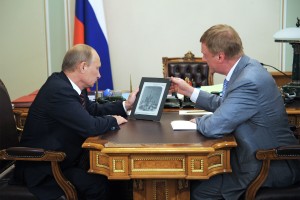
The editorial staff of the Cheka-OGPU and http://Rucriminal.info have obtained transcripts of the interrogation of the former investment director of Rusnano, who worked at the corporation from 2008 to 2022. The witness paints a picture of the evolution of Anatoly Chubais himself and describes the post-Chubais era under Sergei Kulikov.
On February 17, 2026, the Gagarinsky District Court will begin hearing the case of Boris Galkin, CEO of Plastic Logic, accused of embezzlement.
Plastic Logic is the same infamous Rusnano project for which the assets of Chubais and all members of his board of directors have already been seized in the Moscow Arbitration Court.
The witness whose testimony we examined is part of a case related to the Plastic Logic project, but its significance extends far beyond this one case. It is the confession of a professional who witnessed the decline of an institution that was supposed to become a symbol of Russia's technological modernization.
This omission from the investigator's interrogation was not included in the materials submitted to the Gagarinsky Court. It is missing, and perhaps many others are missing as well.
The key change the witness notes occurred not with the projects, but with Chubais himself. While in the early years the emphasis was on investment policy (Andrey Malyshev, a technical specialist and former Minister of Gosgortekhnadzor, serves as Chubais's deputy), after 2013, according to the investment director, Chubais "became tired and gave up."
"He started simulating real processes; Trapeznikov (the press secretary) became the main one instead of Malyshev," the witness draws a direct line: the shift in management priorities led to PR ultimately winning out over production.
The most striking example is the appointment of Boris Galkin, described as "a PR man seconded by Trapeznikov," as director of Plastic Logic. The witness returns to this episode again, emphasizing that the issue was not one of management competence, but of loyalty and media coverage.
An important addition to the transcript is the comparison of the two projects—Crocus and Plastic Logic. While Plastic Logic initially struggled (criticism of the tablet, pressure from the investment committee), Crocus (production of magnetoresistive memory (MRAM)), according to a witness, "was going well—the project itself was interesting, the market, the product—everything raised no questions."
Why did both companies end in bankruptcy? The witness cites fundamentally different reasons:
1. Plastic Logic—"due to the unsuccessful application of the technology. The tablet was a mistake." That is, an internal miscalculation, poor product marketing.
2. Crocus—"the money ran out, sanctions began... There are thousands of factories in China, the scale of production there is different, how can we compete?"
Here, the witness points to a systemic problem that even ideal management cannot address: Russian microelectronics production is fundamentally uncompetitive globally without constant government support. He utters the crucial phrase: "Not a single Russian chip—it's not..." "Russian," hinting at a dependence on foreign components.
The witness compares projects to a person in space.
"He lives as long as he has oxygen. And for a project to break even, it's not enough to finance the capital expenditure (equipment investment), but also a portion of the operating costs during the period until the project breaks even."
Here he points to an institutional failure: the Ministry of Economic Development (MED) has always been against including operating costs in project budgets. As a result, when the funds ran out, projects suffocated.
"By formal criteria, any startup goes bankrupt as soon as the shareholder's money runs out," the witness explains. "All of RUSNANO's successful examples are a result of long-term efforts and faith in the project. It's like working with a child under three."
The darkest and simultaneously sarcastic part of the testimony concerns the period after Chubais's departure in 2020. According to the witness, under the new leadership of Sergei Kulikov, inertia initially persisted, but then "The old managers left, new ones came in. Everything started changing, and chaos ensued."
A special place is occupied by the story of the implementation of "agile" (a flexible management methodology) by a certain manager who came from the Kalashnikov concern. The witness is perplexed:
"Agile is good for AvtoVAZ, where the assembly line is. But he didn't care. And Kulikov didn't even get into any of this. Then the guy disappeared, and agile disappeared."
Then, according to the former investment director, another manager arrived, and the attitude toward projects completely deteriorated: "They stopped coddling projects altogether—like, why bother with them? Invest money—Chubais is to blame, and that's it."
The witness himself left in 2022, "when I realized I couldn't work and imitate. I was right."
His words are a condemnation not of individual managers, but of the entire structure: first, innovation was killed. PR, and then they finished us off with inaction and the “keep a low profile” attitude.


